Introduction
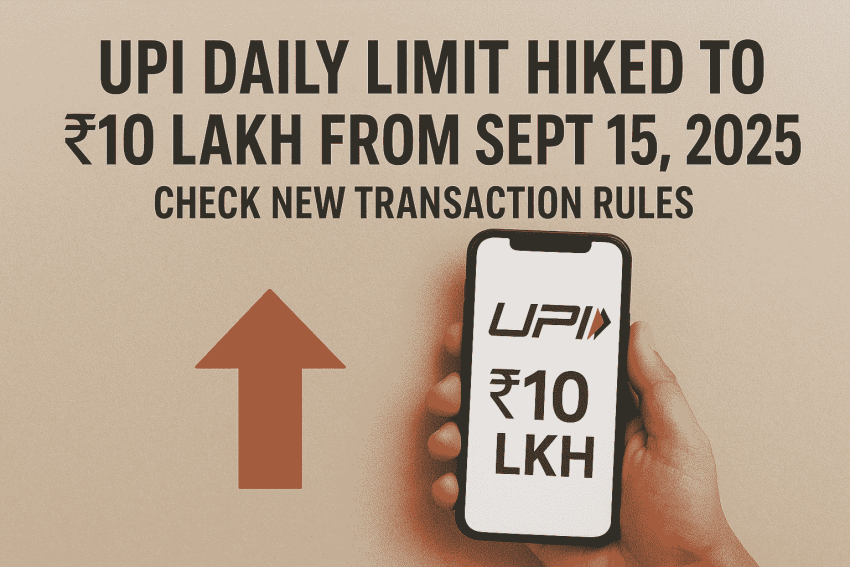
The National Payments Corporation of India (NPCI) is set to revolutionize high-value digital transactions with a significant increase in Unified Payments Interface (UPI) transaction limits, effective September 15, 2025. This much-anticipated move is designed to cater to the growing demand for larger payment capabilities, making it easier for individuals and businesses to conduct high-value transactions seamlessly across various sectors.
UPI has already become the backbone of India’s digital economy, achieving a historic milestone in August 2025 by crossing 20 billion monthly transactions with a total value of ₹24.85 lakh crore. The new limits are expected to further accelerate this growth.
What Are the New UPI Limits?
Under the revised framework, per-transaction and daily aggregate limits for several Person-to-Merchant (P2M) categories have been enhanced. It’s important to note that the standard Person-to-Person (P2P) transaction limit remains unchanged at ₹1 lakh per day.
Here’s a breakdown of the key changes for verified merchant transactions :
-
Capital Markets & Investments: The per-transaction limit is raised to ₹5 lakh, with a daily cap of ₹10 lakh.
-
Insurance Payments: Similar to investments, the limit increases to ₹5 lakh per transaction and ₹10 lakh daily.
-
Credit Card Bill Payments: Users can now pay up to ₹5 lakh in a single transaction, with a daily limit of ₹6 lakh.
-
Travel & Collections: The limits for the travel sector and for loan/EMI collections are now ₹5 lakh per transaction and ₹10 lakh per day.
-
Government Payments: Transactions for the Government e-Marketplace (GeM), including tax payments, are now capped at ₹5 lakh per transaction.
Why This Matters for You
The decision to increase UPI limits addresses a key market demand, eliminating the need for users to split large payments into multiple smaller transactions. This enhancement will bring significant convenience to several scenarios:
-
Investors: Making lump-sum investments in mutual funds or capital markets becomes hassle-free.
-
Policyholders: Paying high-value insurance premiums is now simpler and can be done in a single go.
-
Homeowners: Paying large EMIs or making loan prepayments is more straightforward.
-
Business Owners: Handling high-value transactions for government services or B2B payments becomes more efficient.
While NPCI has set these maximum limits, it is crucial for users to remember that individual banks and payment service providers (PSPs) may set their own lower caps based on their internal risk management policies. All UPI participants, including banks and apps, are mandated to implement these changes by the September 15 deadline.
This strategic upgrade by NPCI not only enhances the user experience but also reinforces UPI’s position as a globally leading digital payment system, paving the way for its further expansion, including a potential integration with the Universal Postal Union (UPU) to simplify cross-border remittances for 192 countries.